Your Worst Angle Might Actually Be Your Best One
The Shot You Almost Deleted
Here's a scenario that probably sounds familiar: you're going through your camera roll, culling through forty-something takes, and you land on one that makes your stomach drop a little. Not because it's bad, exactly — but because it's real. The angle is slightly off from what you planned. The lighting caught something you weren't ready to show. And for a split second, your finger hovers over delete.
Then, on a whim, you post it anyway.
And it blows up.
This isn't a fluke. It's a pattern that creators across platforms — from OnlyFans to Instagram to TikTok — keep running into, and once you understand why it happens, it completely changes the way you think about building your visual identity.
Curated Confidence vs. Real Magnetism
There's a difference between looking good and being compelling, and that gap is wider than most people realize when they're starting out. The angles we plan — the ones we've rehearsed in the mirror, adjusted the lighting for, and retaken six times — tend to broadcast a very specific message: I am in control of how you see me.
And there's absolutely a place for that. Control is its own kind of sexy. But audiences — especially the ones who actually stick around, subscribe, and come back — are hunting for something else underneath the polish. They want a crack in the armor. Not a flaw, exactly, but a glimpse. A moment where the frame feels slightly less manufactured.
The rear view, ironically, is one of the most psychologically loaded angles in content creation for exactly this reason. You can't see your own backside the way your audience does. That inherent disconnect — the fact that you're sharing something you can't fully monitor in real time — creates a vulnerability that viewers pick up on immediately. It reads as trust. And trust is the foundation of every audience relationship that actually converts.
Why the "Safe" Angle Is Often the Boring One
Ask any creator who's been doing this for more than a year where their best-performing content came from, and almost none of them will say it was the perfectly staged, ideally lit, heavily planned set. More often, it's the content that was shot on a Tuesday afternoon with bad lighting and posted on impulse.
That's not an argument against preparation. Preparation matters — knowing your light sources, understanding which focal lengths flatter different body types, learning how to use posture to elongate and define — all of that is real craft. But preparation is the foundation, not the ceiling.
The ceiling is what happens when you trust yourself enough to go off-script.
Creators who've built loyal followings often describe a turning point where they stopped asking does this look like what I'm supposed to look like? and started asking does this look like me? That shift sounds small. It is not small.
Audience Feedback as a Discovery Tool (Not a Verdict)
One of the smartest things you can do early in your content journey is treat your audience's reactions as data rather than judgment. Comments, saves, shares, DMs — these aren't just ego metrics. They're telling you something specific about which version of yourself resonates.
The trick is learning to read feedback without outsourcing your identity to it. There's a meaningful difference between my audience responds to this angle, so I'll incorporate it more and my audience responded to this angle, so now I'm only that angle forever. The first is evolution. The second is a trap.
Successful creators tend to use feedback as a compass, not a script. They notice patterns — maybe the slightly lower camera angle consistently outperforms the eye-level shot, or maybe the natural, unposed moments in stories outperform the polished feed content — and they let those patterns inform their experimentation without letting them calcify into a formula.
The goal is to keep moving. The moment your content feels like you're filling out a template, your audience feels it too.
The Vulnerability Loop
Here's the part that surprises most people: the angles that feel most vulnerable to you are often the ones that feel most intimate to your audience. This isn't a coincidence. It's a feedback loop.
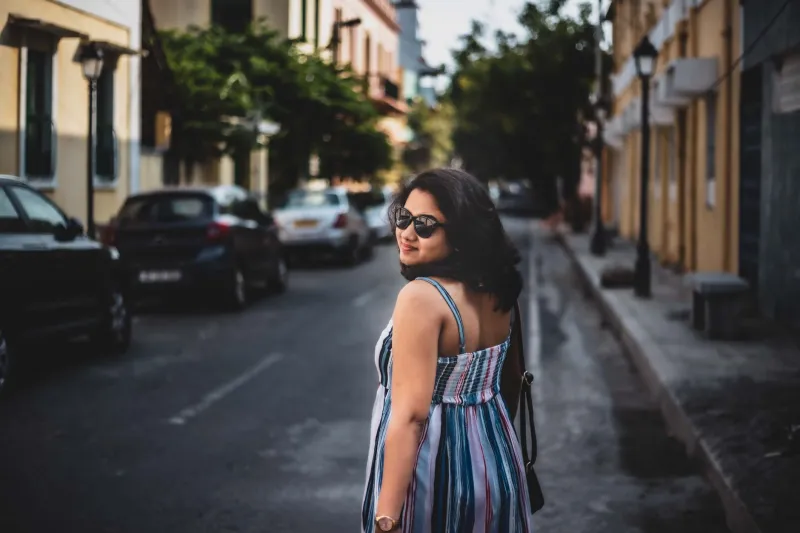
When you post something that made you nervous, that energy — that slight edge of exposure — travels through the image. Viewers can't always articulate what they're responding to, but they feel the difference between content that was produced and content that was offered. The rear view, the candid over-the-shoulder shot, the angle you captured accidentally and almost discarded — these carry a different weight than the poses you've rehearsed.
This is especially true in a media landscape that's oversaturated with perfection. When everything looks filtered and engineered, the thing that stands out is realness. Not sloppiness — realness. There's a difference. Realness is intentional imperfection. It's the choice to leave in the moment instead of cutting around it.
Finding Your Signature Without Copying Someone Else's
The temptation when you're building a visual identity is to model yourself after creators who are already winning. And studying successful people is genuinely useful — you can learn a lot about composition, pacing, and audience engagement by paying attention to what works for others.
But your signature can't come from imitation. It has to come from iteration — posting, watching what lands, adjusting, and posting again. Over time, patterns emerge that are specific to you: the angle that consistently catches your shape in a way that feels true, the lighting situation that makes you feel most yourself, the kind of content that you can produce without overthinking because it's just you.
That's your money shot. And the interesting thing about it is that you usually can't identify it from the outside looking in. You have to stumble into it.
The Permission You're Waiting For
If you've been holding back a particular angle because it feels too raw, too unguarded, or just not polished enough — consider this your nudge to post it anyway. Not every shot is going to hit. But the ones that do are almost never the ones you played it safe with.
The best rear views on the internet aren't always the most technically perfect ones. They're the ones that feel like they were taken by someone who was completely, unapologetically present in their own body — and decided to share that with the world.
That's the paradox. The angle that scares you a little? It might be the one that changes everything.