Mirror, Mirror, Still Not Buying It: When Your Best Self Shows Up But Your Brain Refuses to Agree
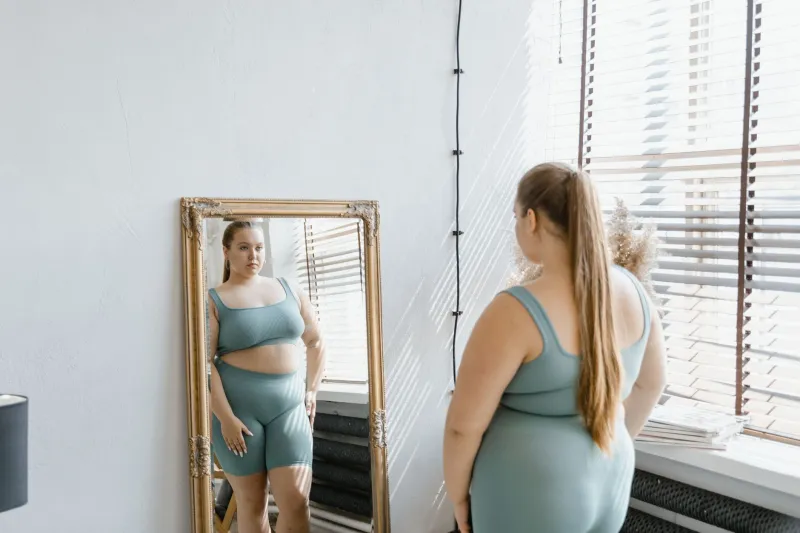
The Compliment That Bounces Off
Somebody tells you your body looks incredible. Maybe it's a comment on a post, maybe it's a person you trust, maybe it's literally a stranger who couldn't help themselves. And instead of landing somewhere warm inside you, that compliment just... ricochets. You smile, say thanks, and immediately think about the seventeen things they obviously missed.
Sound familiar? You're not broken. But you might be running a confidence deficit that no amount of lighting, angles, or genuinely great content is going to fix on its own.
This is the part nobody talks about when they're busy posting their best rear views and racking up engagement. Looking good and feeling good are two completely separate skill sets — and a whole lot of people have mastered one while barely touching the other.
What Imposter Syndrome Has to Do With Your Body
Most people associate imposter syndrome with the workplace — that gnawing feeling that you don't deserve your promotion, your raise, your seat at the table. But the same psychological mechanism runs just as hard in how we experience our own bodies.
You've put in the squats, cleaned up the diet, figured out the angles. By every measurable standard, you've earned the right to feel good. But your brain has a long memory and a skeptical streak, and it keeps pulling up the receipts from years ago — the comments somebody made in middle school, the ex who made you feel like a consolation prize, the locker room moments that never fully faded.
Imposter syndrome in the body confidence space sounds like: This is just a good photo. I don't actually look like this. People are going to figure out I'm not as attractive as they think I am. It's a waiting game where you're constantly anticipating the moment the illusion collapses — even when there is no illusion.
Comparison Culture Is Doing Real Damage
Here's the thing about living in 2024 America: you are swimming in an ocean of other people's highlight reels, and your brain is absolutely terrible at remembering that. Every scroll is a micro-comparison. Every double-tap you give somebody else is, on some subconscious level, a data point your mind files under what I'm not.
Social platforms are engineered to keep you engaged, and nothing keeps humans more engaged than comparison. It's primal. It's also quietly corrosive when you're already struggling to internalize your own attractiveness.
The trap isn't that you're looking at beautiful bodies — that's kind of the whole point of being here, honestly. The trap is measuring your insides against someone else's outsides. You see their best angles and compare them to your worst moments. You see their confidence and assume it's effortless, that they never stood in front of a mirror and talked themselves out of feeling good.
Spoiler: they probably did. They just didn't post that part.
Past Trauma Doesn't Clock Out When You Level Up
This one's harder to talk about, but it matters. For a lot of people, the inability to own their physical power isn't really about their body at all — it's about history.
Bodies carry memory. If you grew up being told yours was wrong, too much, not enough, or something to be ashamed of, that messaging doesn't just evaporate when your circumstances change. It gets layered over, sure. You build new experiences on top of it. But under pressure — under the exposure of putting yourself out there, of being seen — those old scripts can resurface fast.
This is especially true when someone starts gaining visibility or attention they weren't used to. Positive attention can actually feel threatening when your nervous system is wired to expect criticism. The brain interprets unfamiliar positive feedback as suspicious rather than deserved.
None of this means you're stuck. But it does mean that confidence work sometimes has to go deeper than affirmations and good lighting.
Closing the Gap: Practical Moves That Actually Help
So what do you actually do with all of this? A few things that work — not overnight, but genuinely:
Document your own reactions, not just your results. Most people track their progress in photos or numbers. Start also tracking how you felt on a given day — not how you looked. Noticing the disconnect between your physical reality and your emotional state is the first step to narrowing it.
Curate your inputs ruthlessly. If certain accounts consistently make you feel worse about yourself, that's not inspiration — that's punishment. Unfollow without guilt. Your feed should be something that adds energy, not drains it.
Practice receiving. When someone compliments you, try something radical: just say thank you and let it sit there. Don't deflect, don't qualify it, don't immediately pivot to what you're still working on. Let the positive feedback actually reach you, even if it feels awkward at first. It gets less awkward.
Find the difference between performing confidence and building it. There's a version of confidence that's all front-facing — the pose, the caption, the energy you project outward. That's performance, and it has its place. But internal confidence is built in private, in the moments when nobody's watching, when you choose to treat yourself like someone worth taking seriously.
Talk to someone. Not as a last resort — as a legitimate tool. Therapists, coaches, and even trusted communities can help you trace the roots of why external validation isn't sticking. That's not weakness. That's maintenance.
The Realest Flex
Here's what it comes down to: the best angle in the world is only as powerful as the person behind it. If you've done the work — physically, creatively, professionally — and you still can't let yourself own it, that's the next project. Not because you owe anyone a performance of confidence, but because you deserve to actually feel what you've built.
Looking good from every angle is great. Knowing it, in your bones, without needing someone else to confirm it first? That's the real thing. That's what changes how you walk into a room, how you show up online, how you move through the world.
Your body's already doing its part. Time to let your brain catch up.