Lens and Learn: Insider Secrets From the Photographers and Creators Who Make Great Content Look Effortless
Scroll through enough high-quality lifestyle or adult content and you start noticing something: the best stuff feels almost casual. Natural. Like someone just happened to capture a perfect moment. That feeling is a lie — a beautiful, carefully engineered lie — and the professionals behind it have spent years perfecting the craft of making hard work look easy.
We went behind the scenes and talked to photographers, content creators, and producers who work in adult entertainment and lifestyle photography. What they shared was candid, practical, and occasionally surprising.
Light Is Everything. No, Really — Everything.
Ask any professional photographer what separates their work from a smartphone snapshot, and the answer is almost always the same: light.
"Beginners think about the subject. Professionals think about the light," says one Los Angeles-based photographer who has shot for major adult platforms and lifestyle brands for over a decade. "You can have the most stunning person in front of your lens, and bad lighting will destroy it. Good lighting will make almost anyone look incredible."
For lifestyle and body-focused photography specifically, light direction is critical. Side lighting creates shape and definition — it carves out curves, emphasizes muscle tone, and gives skin texture and warmth. Flat, front-facing light (the kind you get from a ring light pointed straight at your subject) tends to flatten everything out.
"Natural window light is still one of the best tools available," adds a New York-based content creator who runs her own production operation. "A large window in the late afternoon, subject positioned at a 45-degree angle to it — that setup has produced some of my most-liked content ever. And it costs nothing."
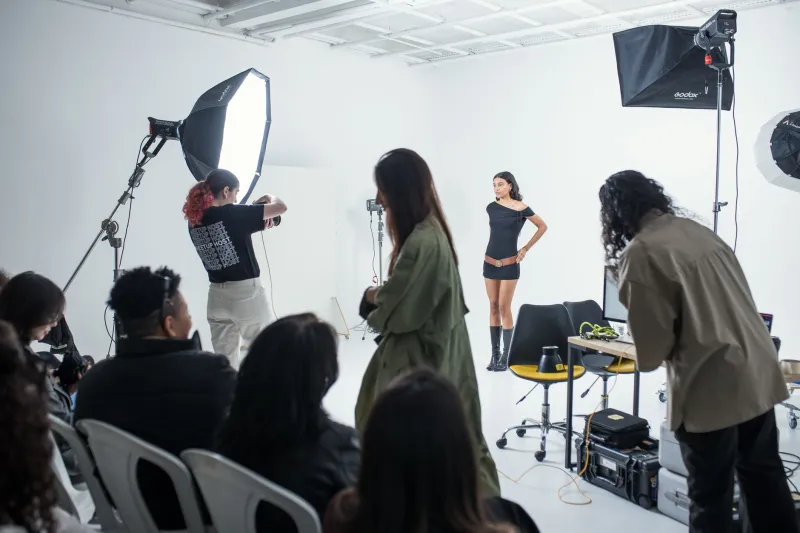
For creators working with artificial light, the pros consistently recommend softboxes over harsh direct flash, and they emphasize learning to control light falloff — how quickly light dims as it moves away from your subject. Understanding that one concept alone will elevate your work significantly.
Angles Aren't Cheating. They're Craft.
One of the most persistent myths in content creation is the idea that shooting from flattering angles is somehow inauthentic. Every professional we spoke to pushed back hard on this.
"Every portrait photographer shoots from angles that flatter their subject. Every. Single. One," says a photographer based in Miami who specializes in boudoir and lifestyle work. "That's not deception. That's craft. It's understanding how three-dimensional bodies translate into two-dimensional images and compensating accordingly."
For rear-view and body-focused content specifically, camera height matters enormously. Shooting slightly below the subject's waist level and angling upward creates length and emphasizes shape. Shooting from directly behind and slightly above can create a completely different, more editorial feel. Neither is wrong — they're just different tools for different effects.
Pose direction is equally important. Small adjustments — a shifted hip, a slightly turned shoulder, a changed foot position — can dramatically alter how a body reads on camera. The best photographers and creators develop a library of these micro-adjustments and apply them intuitively.
"I spend a lot of time studying posing," one creator told us. "Not because I think my body needs to be 'fixed,' but because I want to understand how to show it in the way I intend. That's a skill, and skills take practice."
The Ethics Conversation Nobody Wants to Skip
Professional adult content creation and lifestyle photography come with ethical responsibilities that separate legitimate operations from the rest. This isn't a box-checking exercise — the pros take it seriously, and it shows in the quality and longevity of their work.
Consent documentation is non-negotiable. Every professional we spoke with emphasized that proper model releases, clear agreements about content usage, and explicit conversations about what will and won't be captured are baseline requirements, not optional extras.
"The trust between a photographer and subject is everything," says one producer with credits across multiple major platforms. "The moment someone feels uncomfortable and doesn't feel safe saying so, the whole thing falls apart. Creating a set where people can advocate for themselves freely — that's what makes great content possible."
Beyond consent, there's the question of how subjects are represented. The best creators in this space think carefully about dignity, context, and the message their content sends — not because they're required to, but because it's consistent with producing work they're proud of.
Personal Branding Is a Long Game
For creators building an audience in 2024, the technical skills matter — but so does identity. The most successful people in this space have a clear, consistent point of view that extends beyond any individual piece of content.
"Your brand is the answer to the question: why should someone follow you specifically?" explains one digital producer who consults with emerging creators. "It's not just your aesthetic. It's your personality, your values, your sense of humor, how you engage with your audience. All of that is content, even when you're not posting."
This is where a lot of technically skilled creators stall out. They can produce beautiful images but haven't figured out what makes them them — and audiences can feel that absence. The solution isn't to manufacture a persona. It's to identify what's already genuinely interesting about your perspective and lean into it consistently.
Posting frequency matters, but posting consistency matters more. A creator who posts three times a week, every week, with a recognizable style and voice will outperform someone who posts irregularly at higher volume almost every time.
Gear: Spend Smart, Not Big
Here's a truth the camera industry doesn't love: you don't need expensive gear to produce professional-quality content. You need to understand the gear you have.
Most modern smartphones shoot video and stills that are more than adequate for social platforms and many professional applications. The limiting factor is almost never the camera. It's lighting, composition, and the photographer's eye.
That said, if you're investing in gear, the pros consistently recommend prioritizing lenses over camera bodies (for DSLR and mirrorless shooters), and investing in a quality tripod before almost anything else. Stability is underrated, especially for solo creators who are shooting themselves.
The Real Secret
Every professional we talked to circled back to the same idea eventually: the best content comes from subjects who are genuinely comfortable. Comfort creates authenticity. Authenticity creates connection. Connection is what keeps people coming back.
Technical skills get you in the door. But the ability to make someone feel at ease in front of a lens — to help them access their own confidence and show it off — that's the thing you can't fake, and it's the thing that makes the difference between content that performs and content that resonates.
At Show Me Butts, we see that difference every day. And now you know what's behind it.